The Blue Crates
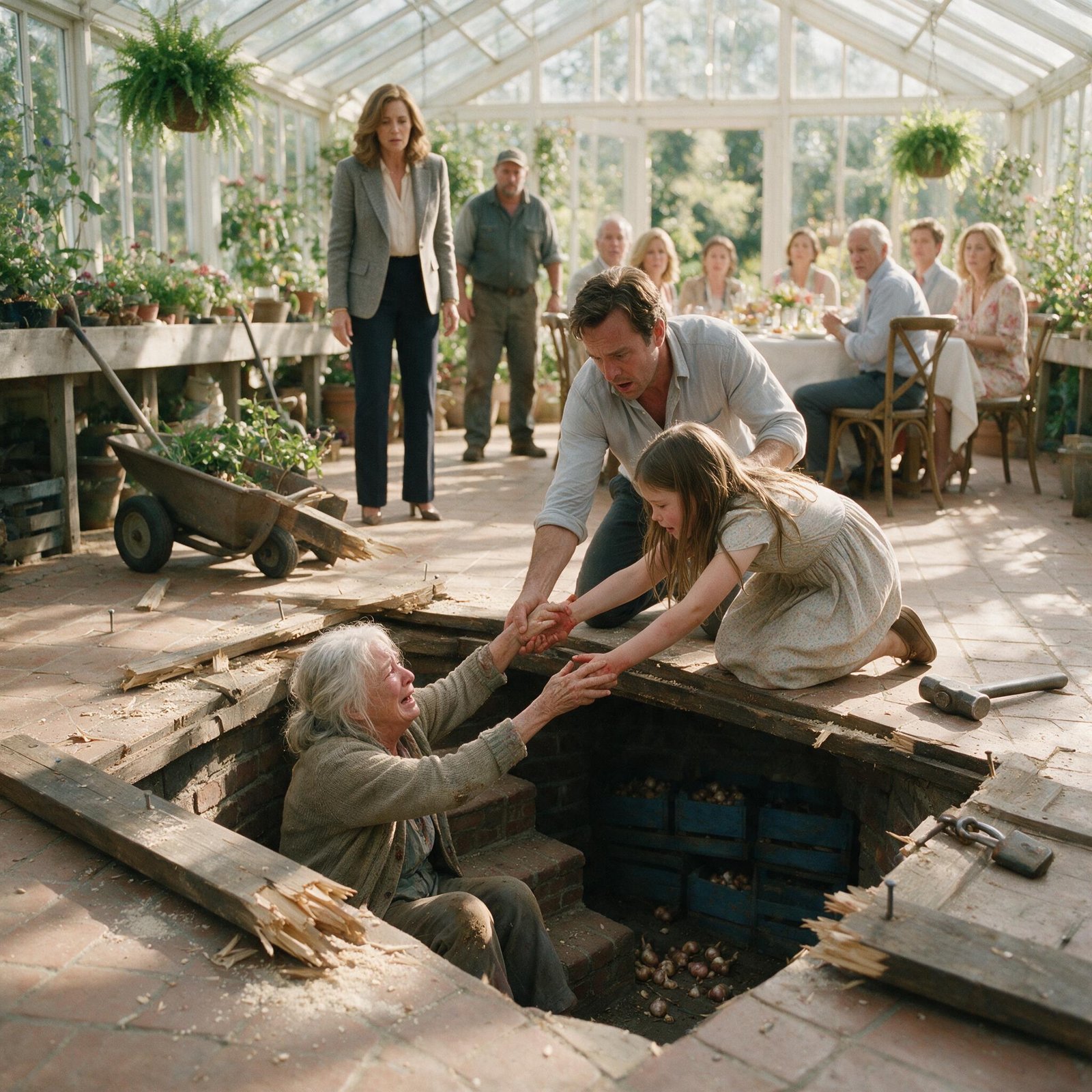
By late afternoon the brunch table had been cleared, the broken hatch had been roped off, and Lily sat on the floor beside her grandmother's chair with her back against the warm glass.
Evelyn had a blanket around her shoulders and the same tremor in her hands that had been there since the paramedics left.
They had called her shaken and tired but alert, and Lily had waited for that to feel like good news.
It did not, because Aunt Diane was gone and nobody would say where.
Her father stood out past the glass doors, talking low to the two officers who had come in behind the ambulance.
Beyond the rope, the open hatch showed three steps and a row of blue crates, and Lily kept looking at them instead of at the splintered boards, because the boards made her hands hurt again.
“You can ask me,” Evelyn said.
“Why did you go down there?”
“Because those crates are mine to protect, and because I still believed an argument with my daughter had a bottom to it.”
The Calder lilies had started three generations back with six bulbs that survived a winter which killed nearly everything else on the estate.
Evelyn had spent forty-seven seasons choosing the strongest plants, dividing them by hand, and carrying the dormant bulbs back down after every flowering.
Lily knew that part without being told, because she had held the crate lid open for the past four springs.
“They were never a fortune,” Evelyn said.
“They were the only thing this family kept touching with its hands.”
The estate sale had been Evelyn's own idea, and she made Lily hear that twice.
She wanted a smaller house on one level, a garden she could reach, and enough freedom left to spend on her granddaughter instead of roofs and acres of glass.
Mark had asked three times whether she was certain, and three times she had said that downsizing was not surrender.
Diane had not forced any of it, and Evelyn refused to let this morning rewrite that.
Gabriel Rosa had been sorting dormant bulbs for the brunch display when he found soft brown decay at the base of two of them and a pale growth caught between the folded scales.
He carried them straight to Evelyn without naming a disease, because he knew the difference between seeing something and proving it.
Evelyn had ordered every blue crate left in the cellar, apart from the tools and the outgoing plants, until Dr. Naomi Bell could examine the collection properly.
Rosa reached the specialist that same hour, and she agreed to come in two days.
“Two days,” Evelyn said. “That is all I asked anyone for.”
Diane had treated those two days as a humiliation staged for an audience that had not even arrived.
She wanted the blue crates carried up into the bright center aisle, stacked where every buyer walking the conservatory would see the family name painted on the wood.
Lily understood that part better than the rest, because she had watched her aunt arrange the brunch flowers three separate times that morning.
Evelyn had told her that nothing living would be moved or displayed while its condition was uncertain.
“One damaged bulb does not condemn forty years of work,” Diane had said.
“Then waiting one day will not diminish it,” Evelyn had answered.
Diane had pointed at the cellar and told her to go see for herself how little Rosa had actually found.
So Evelyn had gone down the three steps voluntarily, and Diane had followed her far enough in to look at the crates and call the suspicious material bad-looking dirt.
Then Diane climbed back up ahead of her.
Evelyn had turned to drag one blue crate away from the row, toward the steps, so she could carry it up into the light and settle the argument herself.
That was when the hatch dropped.
“I heard the latch, and then I heard hammering,” Evelyn said. “I called her name until I lost it.”
Lily thought about the eight strikes it had taken her, and about how long thirty-four minutes was when you were the one underneath counting them.
Nobody had tied Evelyn or gagged her or touched her at all, and Lily was old enough to understand that this had not made her grandmother one bit more free.
“The frightening part was not that she planned it,” Evelyn said. “It is that she did not have to.”
Lily leaned into her grandmother's arm and stopped asking.
Evelyn was grateful, because the rest of the answer was still sitting down there in crates she was not qualified to judge.
She asked Mark to keep the conservatory shut overnight, and she told Rosa that not one bulb, not one tool, not one handful of cellar soil was to leave the building before Dr. Bell arrived.
Through the opening she could see the crate she had dragged toward the steps, sitting exactly where she had left it, and she remembered Diane watching that crate instead of watching whether her mother could still breathe.
Her daughter had risked a living person to keep the Calder lilies moving.
What Evelyn did not know yet, and what kept her awake behind her granddaughter's steady hand, was whether that ruined bulb was a single loss or the first mark across everything her family had saved.
Part 3 of 5 · The Girl Who Tore Open Grandma's Cellar