The Words Beneath the Wood
The next morning, a marina tow crew moved the yacht without engaging its engines to an adjacent service berth.
Laura stood with Kate at the guarded berth while the surveyor positioned padded supports around the aft bench.
Emma had chosen to stay with the child advocate and Laura's cousin instead of returning to the marina.
Laura was relieved that her daughter had been offered a choice no one tried to reinterpret as fear or bravery.
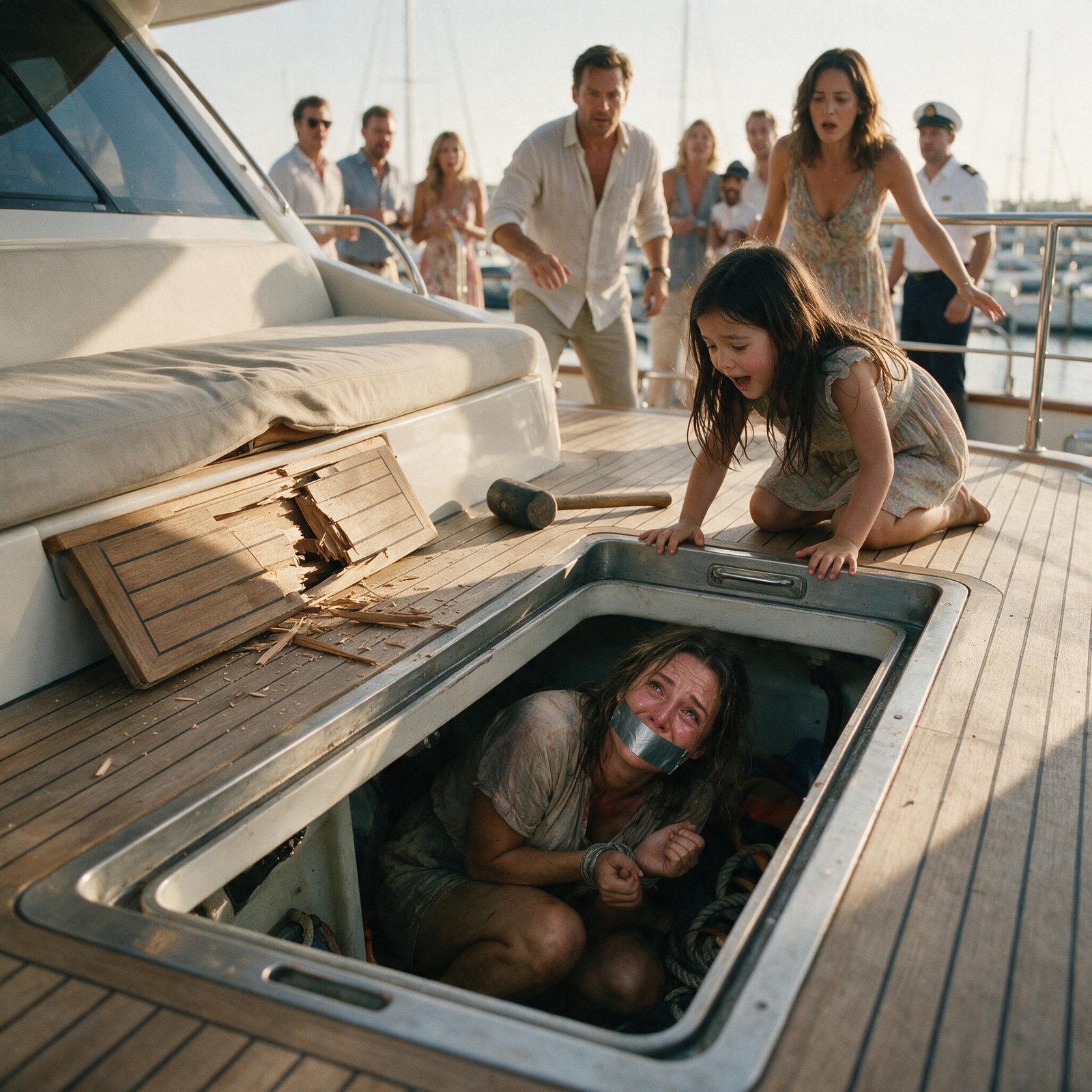
An investigator documented each stage while the marine surveyor removed the cushion, released the concealed end catches, and lifted away the surviving horizontal seat-base insert.
No one struck the insert or recreated Emma's blows.
The surveyor then removed the nonfactory fasteners and fixed edge trim that still crossed the original metal hatch.
Only when the last piece of trim lifted did embossed letters appear across the manufactured metal hatch.
EMERGENCY EQUIPMENT — KEEP CLEAR.
Laura read the words twice before their meaning reached her.
The marking had not been missing, faded, or hidden inside the compartment.
It had been facing the deck all along, covered by the varnished horizontal seat-base insert Greg had ordered.
The surveyor explained that the hatch opened into the aft emergency-equipment locker, which held throwable flotation, a signaling kit, a fire blanket, and emergency-tiller components.
The words named it for what it had always been: the locker that was supposed to save them.
The thirteen wearable life jackets checked on deck were separate equipment and had never been stored in this locker.
The metal hatch itself still worked, but the seat-base refit had made it slower to identify and impossible to open without first moving or breaking the obstruction.
No manufacturer had designed the yacht that way.
Laura remembered Greg selecting the varnished insert five weeks earlier and dismissing her concern when the original metal rim disappeared beneath it.
The fitted varnish edge, matching fastener pattern, and worn concealed catches confirmed that the insert was an owner-requested refit rather than damage Emma had displaced.
Nothing showed that Greg had ordered the refit as a place to confine someone, but he knew what it covered when he chose that locker for Laura.
The same alteration that hid the locker from casual view had hidden a living woman from the people standing above her.
Laura remembered the coiled ropes against her shoulder and the hard shapes along the fiberglass wall.
She had been folded among equipment that was supposed to help people survive an emergency.
Greg had turned its access into decoration, then turned the inaccessible space into a hiding place.
His engine order exposed the same wager: he believed family pressure would make Mara reverse the dockside decision before anyone learned why the cruise had stopped.
The failed child buckles and unverified suppression service had supported Mara's original dockside decision.
The obstructed hatch and Greg's premature engine order were later evidence of what his refit concealed and how he tried to override that decision.
Laura's bound wrists, the tape, the utility line, the externally covered hatch, her account, and the witnesses who saw Greg fight Emma's rescue established what he did to her.
The safety findings explained his urgency, but they did not have to carry the restraint case.
Captain Mara's refusal needed no secret explanation because she and the deckhand had followed their duty and rejected an unauthorized departure.
For weeks afterward, Laura heard relatives describe Emma as the girl who destroyed Greg's yacht.
Each time, Laura corrected the sentence.
Emma had broken a replaceable section of the horizontal seat-base insert that never should have covered the hatch.
Her strikes restored access to emergency equipment and exposed what polished surfaces had concealed.
The yacht remained dockside until qualified workers removed the obstructing refit, replaced the failed jackets, verified the suppression system, and received surveyor clearance.
On a separate track, protective orders kept Greg away from Laura and Emma while the restraint case proceeded on witness and physical evidence.
Months later, a plea and continuing protective conditions closed that case without making the safety concerns substitute for proof of violence.
Laura did not measure the outcome by whether Greg finally admitted why safety had mattered less to him than status.
She measured it by doors he could no longer close and decisions he could no longer make for Emma.
The following spring, a community boating program offered a dockside safety class for families who wanted one without committing to a trip.
Laura showed Emma the invitation and made clear that throwing it away was an acceptable answer.
Emma kept it on the refrigerator for six days before asking to go.
At the class, an instructor fitted Emma with a child-size life jacket and asked her to pull every buckle herself.
Each buckle held.
The instructor checked one properly fitted wearable jacket for every person before anyone boarded the training boat.
Its emergency-equipment hatch was marked in black letters, fully visible, and clear of cushions, bags, and decorative trim.
Emma opened it once, closed it once, and returned the handle to its recessed position.
When the instructor offered a choice between staying dockside and making one slow loop inside the protected basin, Laura kept her answer to herself.
Emma looked at the open hatch, the fitted jacket, and the captain waiting for her decision.
Then she took Laura's hand and chose the water.
Part 5 of 5 · The Girl Who Destroyed Her Stepfather's Yacht