The Castle Was Bait
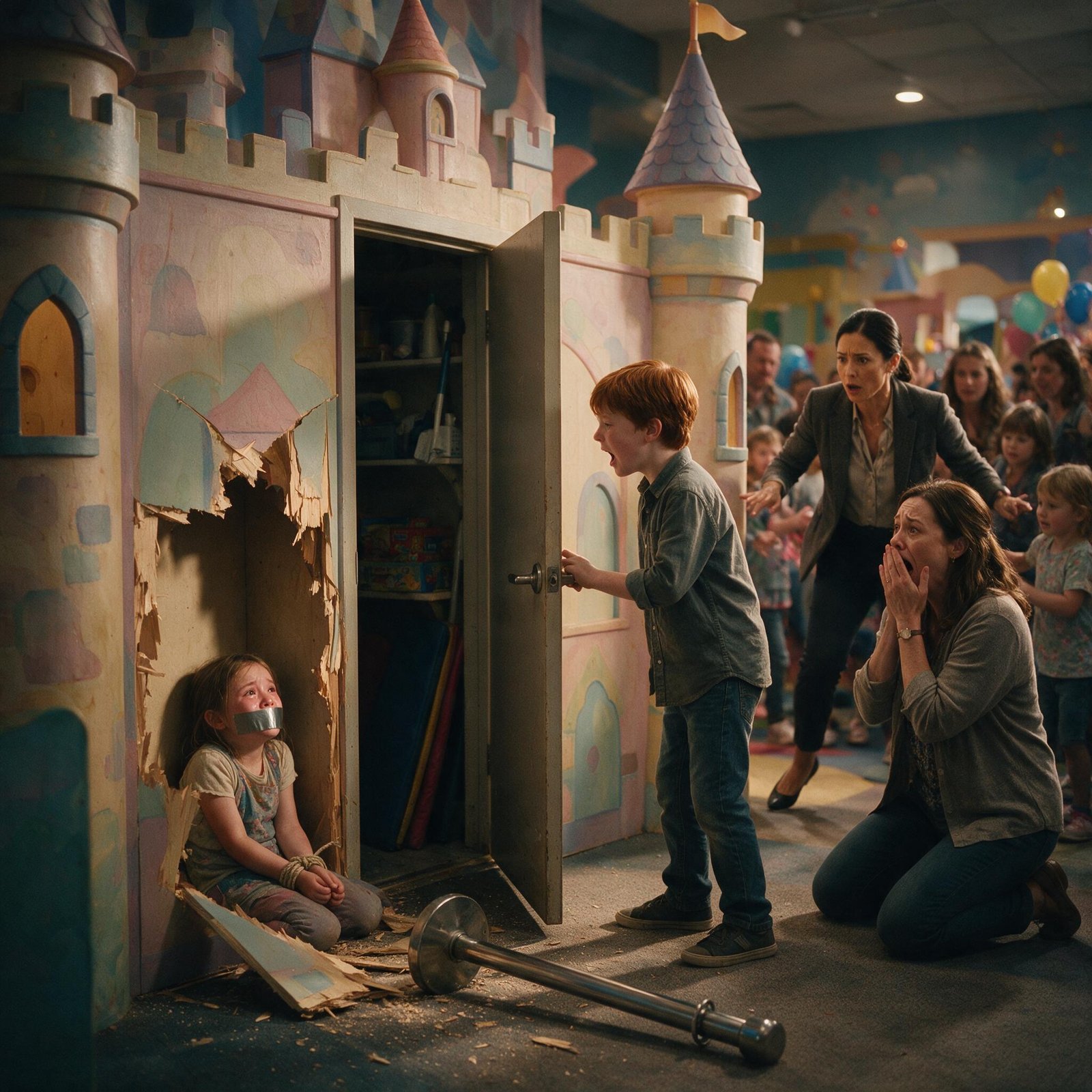
After Nina finished, Emily remained beside the north wall while the investigator asked everyone to review the sequence once more.
No children were present, and nobody imitated Sophie's knocks or Noah's swing.
They began with the facts that did not require anyone to guess what Carter had intended.
Sophie had described Carter leading her through the service door, tying her wrists with costume ribbon, taping her mouth, and leaving her inside the closet.
The ribbon, tape, wrist marks, shallow room, Nina's no-pickup account, and witnesses to Carter's interference supported her statement.
Whatever the post meant, Sophie had already named the adult who tied her.
The remaining question concerned why Carter had created such a specific set of conditions.
The investigator warned that an explanation could be strongly supported without becoming a direct view into another person's mind.
Eighteen days before the event, Noah reported Carter's rough restraint of a crying child beside an open classroom.
Emily submitted the complaint that same day.
At the preliminary board meeting six days later, Carter answered the safety concern with a judgment about Noah.
“He breaks things when he wants attention.”
Twelve days after that meeting, the same board and several major donors attended the center's ordinary charity event.
Their presence was public and expected rather than secretly arranged.
Carter moved one heavy queue post from reception to the only thin section of the castle wall.
She told staff to watch Noah before he acted and asked three times whether he had reached the castle.
She placed Sophie behind that wall after telling her to call Noah once and tap until he came close.
Then she left the post where a twelve-year-old could reach it.
The pattern supported one narrow and ugly conclusion: Carter likely wanted a public strike, not a rescue.
One impact would produce a loud bang and an alarming image of Noah holding a metal post while the plywood remained closed.
Carter could take the post, staff could remove Noah, and adults already primed by her warning could interpret the damage before they examined the danger behind it.
After the room cleared, the side service door would let Carter release Sophie and remove the ribbon and tape before most adults saw them.
Carter could call it a castle game that Noah turned into an outburst and accuse Emily of coaching both children once questions began.
That gamble was reckless and unlikely to withstand a careful look at Sophie's wrists or separate interviews with the children.
It was not a long-term cover, but an attempt to control the first minutes, attach a violent image to Noah's name, and make the board discount both children before examining the physical facts.
Sophie was the sound that would bring Noah to the wall.
The post was the object Carter expected him to choose.
The adults nearby were the people she expected to believe what they saw before asking what he had heard.
No witness knew every sentence Carter planned to use, but the conclusion rested on timing, placement, prior labeling, and independent statements without requiring her cooperation.
Emily remembered the moment the first part of the plan stopped behaving as Carter likely expected.
Noah did not accept the pickup claim or leave after the first crack.
Emily entered the exchange and demanded Sophie's location.
Carter's answer about a nonexistent sister came only then, after the simple outburst story had begun to fail.
Nothing suggested the line had been prepared; its timing instead supported a panicked improvisation from a director losing control.
Sophie kept knocking, Noah retrieved the post, Nina refused to help remove him, and the families stayed close enough to see the real door open.
Carter had relied on each person stopping at the easiest explanation.
They did not stop together.
One board member admitted that the earlier complaint had become a discussion of Noah's temperament because questioning a child felt easier than confronting the director.
Emily insisted that admission remain in the independent safeguarding findings.
None of those adult findings stopped Noah from asking whether people believed only what a broken wall forced them to see.
Emily answered the question the same way each time.
“Your words should have been enough before there was a wall.”
The following spring, the Hartleys attended an ordinary Saturday program at their neighborhood recreation center.
By then, the children's center had a new governing board and child-protection policies, a licensing decision barred Carter from managing another children's program, and the criminal case had reached a court-supervised resolution based on Sophie's restraint and endangerment.
The recreation center's play area included a simple wooden house with four open arches.
Sophie watched it from Emily's side for several minutes before walking through one arch and out another.
Noah remained near the entrance until Sophie reached back for him.
He asked Emily whether she still saw him as the boy who destroyed the castle.
Emily told him the damage belonged to the emergency Carter created, while his choice had been to keep listening when adults ordered him away.
Noah took Sophie's hand and entered through the open arch.
This time, nothing stood between a child's voice and the people who needed to hear it.
Part 5 of 5 · The Boy Who Destroyed the Children's Castle